
US military jets and drones tracked near Cuba as tensions rise
May 20, 2026 International Source: BBC World



×
![Popup Image]()
Tracking data shows several flights by US Navy reconnaissance jets and drones during the last week.
Cuba: Flight tracking shows US surveillance aircraft near island as tensions continue
Copyright current_year BBC. All rights reserved. The BBC is not responsible for the content of external sites. Read about our approach to external linking.
Copyright current_year BBC. All rights reserved. The BBC is not responsible for the content of external sites.
Read about our approach to external linking.
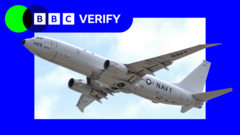
A P-8 Poseidon in flight, with the BBC Verify logo superimposed next to it
US military jets and drones tracked near Cuba as tensions rise
The US military has been publicly broadcasting the location of military surveillance flights near Cuba on plane-tracking websites, as Washington continues to exert pressure on the island's communist leadership.
Leaving flight transponders on "is likely deliberate", said UK drone expert Dr Steve Wright, with the US intending to send "a clear message it has eyes in the sky to maintain the squeeze".
BBC Verify analysis of data from flight-tracking website Flightradar24 shows at least five US Navy P-8A Poseidon surveillance aircraft and three MQ-4C Triton surveillance drones have been operating in the Caribbean near Cuba since 11 May. Some aircraft have flown as close as 50 miles (80km) from the island.
Flight-tracking data cannot give a complete picture of US activity off Cuba as military aircraft do not always broadcast their positions but share their location for portions of a flight.
The deployment of these aircraft comes as US-Cuba tensions have risen significantly in recent months, after Washington imposed an effective oil blockade on the Caribbean nation.
It has also been reported by news site Axios that Havana has acquired drones capable of attacking the US mainland, which Cuba's foreign minister responded to by saying the country "neither threatens nor desires war" and accused Washington of building a "fraudulent case" for military intervention.
It has also been reported by news site Axios that Havana has acquired drones capable of attacking the US mainland, which Cuba's foreign minister responded to by saying the country "neither threatens nor desires war" and accused
Washington of building a "fraudulent case" for military intervention.
These accusations were followed by US Secretary of State Marco Rubio offering a "new relationship" with the Cuban people on Wednesday.
Speaking in Spanish on the anniversary of Cuba's independence from the US in a direct address to the island's population, Rubio blamed the island's "unimaginable hardships" on its communist leadership - and not the US fuel blockade.
Experts told BBC Verify the public nature of these surveillance flights indicates the US is seeking to enforce the blockade and apply pressure on the Cuban government as well as deterring its allies like Venezuela from attempting to get energy shipments to the island.
The resulting fuel crisis has led to major power blackouts and triggered protests in Cuba. President Donald Trump has also put Cuba under significant pressure to "make a deal" and threatened its communist regime that the US could intervene like it did in Venezuela earlier this year when it captured President Nicolás Maduro.
BBC Verify has tracked several flights by US Navy P-8 Poseidon surveillance jets including one on 11 May when the aircraft got within 50 miles (80km) of southern Cuba, according to Flightradar24 data. The P-8 continued to operate into the following day, when it was seen flying to the north of Cuba's capital Havana before returning to its base in Jacksonville, Florida.
A map of Cuba, Florida and surrounding areas, a flight path of a P-8A Poseidon on 11-12 May. The aircraft flies eastwards in a flight path to the south of Cuba along its entire length, loops around on itself and flies back. The tracking signal cuts out to the west of Cuba and then returns directly to the north to the west of Florida.
On 15 May, two US MQ-4C Triton surveillance drones also operated off the coast of southern Cuba, with tracking showing them operating along a route similar to one previously flown by a Poseidon.
ALT: A map of Cuba, Florida and surrounding areas, a flight path of a MQ-4C Triton on 15 May. The drone flies eastwards in a flight path to the south of Cuba along its entire length. In the west of the island it loops around on itself and then returns back on itself.
Mark Cancian, a retired US Marine Corps colonel and senior adviser at the Center for Strategic and International Studies (CSIS), told BBC Verify the recurrent flight paths of the surveillance aircraft "indicate an intention to spot ship arrivals from the south, primarily, and secondarily from the north".
"None of the flights are over land, so this is not some preparation for invasion," he said. Cancian added he doubts these flights are "routine", given the number of P-8s and MQ-4C Tritons the US has at its disposal are "limited".
BBC Verify also examined US military aircraft activity near Cuba between 1 and 7 February, which saw only one P-8 fly in the vicinity of Cuba and no comparable MQ-4C Triton activity near the island. However, a US Air Force RC-135V Rivet Joint reconnaissance aircraft did conduct two passes of the island over the period.
Drone expert Steve Wright told BBC Verify the drone surveillance flights "are most likely part of a US agenda to deter attempts by Venezuela to breach the oil blockade and ship fuel into Cuba".
Analysts from defence intelligence firm Janes offered a similar assessment, as well as saying there had been a "general increase in US intelligence, surveillance, and reconnaissance sorties" since February.
"The fact that these flights are visible through open-source tracking tools suggests they are intended to deter attempts to break the oil blockade and apply pressure on the Cuban government," Janes told BBC Verify.
What do you want BBC Verify to investigate?
A man cooks with firewood during a blackout in Havana
Cuba accuses US of building 'fraudulent case' for military action
Raul Castro wearing a suit with red tie and wire framed glasses, and pointing a finger while speaking
US planning to charge ex-Cuban leader Raúl Castro
A man cooks with firewood during a blackout in Havana on May 13, 2026.
CIA chief visits Cuba as energy crisis worsens
The change reflects increasing supply concerns over certain fuels due to the effective blockade of the Strait of Hormuz.
Motoring group RAC warns pump prices could keep rising if there is no resolution to the Iran war.
Energy markets have been on a wild ride as the key Strait of Hormuz waterway remains effectively closed.
It comes as the US weighs whether to proceed with a $14bn arms sales to Taiwan, which China claims as its own.
BBC correspondent Will Grant reports from Havana, hours after the US charged former Cuban leader with conspiracy to kill US nationals and other crimes.
Cuba's current president says the charges against Castro - including conspiracy to kill US nationals and destruction of aircraft - are a "political manoeuvre".
Some lawmakers and legal experts say the department has violated federal law with its addendum to the settlement.
Larry Bushart spent 37 days behind bars for a meme he shared on Facebook after the killing of the conservative commentator.