
UK scientists developing Ebola vaccine that could be ready for trials in months
May 22, 2026 International Source: BBC World



×
![Popup Image]()
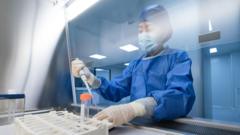
The rare species of Ebola involved - known as Bundibugyo - kills around a third of those infected and has no proven vaccine yet.
UK scientists developing Ebola vaccine that could be ready for trials in months
Copyright current_year BBC. All rights reserved. The BBC is not responsible for the content of external sites. Read about our approach to external linking.
Copyright current_year BBC. All rights reserved. The BBC is not responsible for the content of external sites.
Read about our approach to external linking.
The image shows a laboratory setting with bright, clean lighting and smooth surfaces. A person is wearing protective clothing, including a blue gown, gloves, a face mask, and a head covering. The person is using a pipette to transfer liquid into a small tube placed in a rack. A clear protective barrier is positioned in front of the workspace, suggesting a sterile or controlled environment. The background includes lab equipment and reflective surfaces, reinforcing the clinical and scientific atmosphere.
Scientists at Oxford University are developing a new vaccine that could be ready for clinical trials within two to three months to help tackle the Ebola emergency.
The outbreak, centred on the Democratic Republic of Congo, has resulted in 750 suspected cases and 177 deaths.
The rare species of Ebola, known as Bundibugyo, for which there is no proven vaccine, kills around a third of those infected.
There are no guarantees the vaccine will prove effective and it will take animal research and trials on people to know if it will be.
But scientists say they are working urgently in case the outbreak spirals and their experimental vaccine is needed.
The risk from the current Ebola outbreak has now been upgraded from "high" to "very high" in the Democratic Republic of Congo, by the World Health Organization (WHO).
In the wider region the risk is also now considered to be high but it remains low internationally, it added.
This comes after the WHO declared a public health emergency of international concern on Sunday, when it stressed that the outbreak was not a pandemic.
Another separate experimental Bundibugyo vaccine is also in development, but it is expected to take six to nine months for any dose of that to be ready for testing.
Map of eastern DR Congo and Uganda showing areas affected by an Ebola outbreak. Shaded red regions mark locations with reported cases, concentrated in Ituri province, including Mongwalu, Rwampara, Nyakunde, and nearby Bunia, identified as the site of the first suspected case. Additional smaller affected areas are shown around Butembo, Goma near the Rwanda border, and a location near Kampala in Uganda, where cases were confirmed in travellers from DR Congo. A locator inset highlights the region within Africa.
The vaccine being developed by UK scientists uses the same technology the team developed during the Covid pandemic.
It is a highly adjustable technology - known as ChAdOx1 - that can be quickly tweaked so it works against different infections.
During the pandemic it was loaded with genetic code from the Covid-virus.
This time it has been prepared with genetic code from the Bundibugyo species of Ebola.
It uses a common cold virus that normally infects chimpanzees but has been genetically engineered to make it safe for people.
Researchers use this modified cold virus to carry and deliver important genetic material about the Bundibugyo Ebola virus to cells, instructing them to recognise and fight off the actual disease.
The vaccine does not cause an infection or Ebola symptoms, but trains the immune system to give protection.
The WHO said earlier this week that there was no animal data yet to support the effectiveness of this particular vaccine.
"It is possible that doses of that could be available for clinical trial in two to three months, but there is a lot of uncertainty," a spokesman added, saying it would depend on animal trials as to whether it could be considered "a promising candidate research vaccine" for Bundibugyo.
The BBC understands that animal testing is now under way in Oxford.
The Serum Institute of India is lined up to mass produce the Ebola vaccine once Oxford can supply medical-grade material.
Prof Lambe, the Calleva Head of Vaccine Immunology at the Oxford Vaccine Group, told BBC News: "Once we get starting material to them they can go fast and they can go big."
The WHO says the vaccine could be available for use in clinical trials in two to three months.
Lambe says speed is a priority: "People are worried about this outbreak, generally, you prepare for the worst case scenario - hopefully contact tracing and quarantine is all that's needed, but we can't take our foot off the gas."
Bubble chart titled “Rare virus species behind latest Ebola outbreak,” where circle size represents confirmed cases. A very large purple circle shows the 2014–16 West African epidemic with 28,715 cases, far exceeding others, alongside a smaller 2018–20 outbreak with 3,470 cases. Smaller clusters represent Zaire, Sudan, and Bundibugyo virus outbreaks; Sudan shows moderate case circles, while Bundibugyo includes a highlighted 2026 outbreak with over 50 confirmed and more than 600 suspected cases. A note states Ebola was first detected in 1976 and that case numbers may be underestimates. Source: CDC, WHO.
This current Ebola outbreak is challenging because it is caused by a rare species of the virus.
There are six species of Ebola virus, but only three cause large outbreaks in people.
Bundibugyo has only caused two previous outbreaks - in Uganda in 2007 and DR Congo in 2012 - and has not been seen for over a decade.
There is an Ebola vaccine for the more common Zaire species of Ebola, but there is no proven vaccine for Bundibugyo.
Health workers wearing protective equipment stand outside the General Referral Hospital during the Ebola outbreak response on May 21, 2026 in Mongbwalu, Democratic Republic of Congo.
The image shows a partially open building with a shaded interior and a dirt ground outside. In the foreground, two individuals are standing and wearing full protective gear, including blue gowns, gloves, face masks, and clear face shields. One individual appears to be gesturing with gloved hands, while the other faces toward them, suggesting a conversation or coordination. In the background, several people are sitting or standing under the roofed area, some near parked motorcycles and a wall with a window.
Ebola vaccines would not be used en mass in the same way as during the Covid pandemic.
Instead, they are used in a technique called ring vaccination - where only the people most likely to get infected are immunised, including the close contacts of cases of Ebola as well as healthcare workers who are treating sick patients who can be very infectious.
The Oxford research team had already been working on similar vaccines for the Sudan species of Ebola virus and Marburg virus.
BBC Your Voice banner image. Your Voice is written in white against a purple background.
What questions do you have about the Ebola outbreak?
Please include a contact number if you are willing to speak to a BBC journalist. You can also get in touch in the following ways: Email: yourvoice@bbc.co.uk Tweet: @BBC_HaveYourSay And you can send us a video note by using this link .
A person wearing a mask and peach headwrap is having their temperature checked with a contactless thermometer near their ear. it reads 36.3 degrees.
'Ebola has tortured us': Fear grips eastern DR Congo as deadly virus spreads
A medic checks the temperature of a woman, using a contactless infrared thermometer. Only the arm of the medic, who is wearing white, is shown. The woman having her temperature checked has her hair in braids. She is wearing a bright blue top with a pattern and is standing next to a blue wooden door with a white and blue building in the background.
What is Ebola and why is stopping the latest outbreak so difficult?
The image shows three individuals in the foreground wearing full-body protective suits in bright yellow, along with white hoods, face masks, and gloves. Two of the individuals are helping adjust or fasten the protective gear of a third person, focusing on securing the hood or mask around the head and neck area. The setting is outdoors, with a blurred crowd of people and buildings visible in the background, suggesting a public or community environment. Additional people in the background are also wearing protective clothing. The lighting is natural daylight, and the scene emphasizes careful preparation and attention to safety procedures.
How worrying is the Ebola outbreak in DR Congo?
Researchers believe a previously-unknown property of a protein could lead to new medical treatments.
New research amongst young people looked at how a sense of purpose in life can impact on wellbeing.
Dr Richard Holliday says the information gathered will be used to inform future health guidance.
What to look for when choosing sunscreen and how to apply it to get the maximum protection.
Grieving relatives and friends of a suspected Ebola victim were prevented from taking his body for burial.
The provision at Hereford's County Hospital is designed to help patients avoid travelling to other sites.
In her new book, The 21st Century Brain, scientist Hannah Critchlow explores the overlooked skills that will be necessary to flourish in the age of AI – and how we can cultivate them.
The India-Africa summit was set to be held next week in Delhi after more than a decade.